Will AI move beyond the corporate walls?
Every morning, before I can ask AI what we should do, somebody still has to establish what is true.
If a company trades LVL beams or natural birch plywood, the useful questions are very concrete. What do our suppliers actually have in stock today? At what price and under which terms? Did a competitor change its price? Is a truck available on the lane we need? Has a construction company announced a project where our material fits? Did a university in Boston open a furniture supply tender?
The answers exist somewhere. Usually they arrive through calls, emails, spreadsheets, manager chats, vendor portals and websites built for a person with a mouse.
Then AI receives the result and makes a summary.
That is useful. It is also a small part of what this technology should eventually do.
AI still stops at the company door
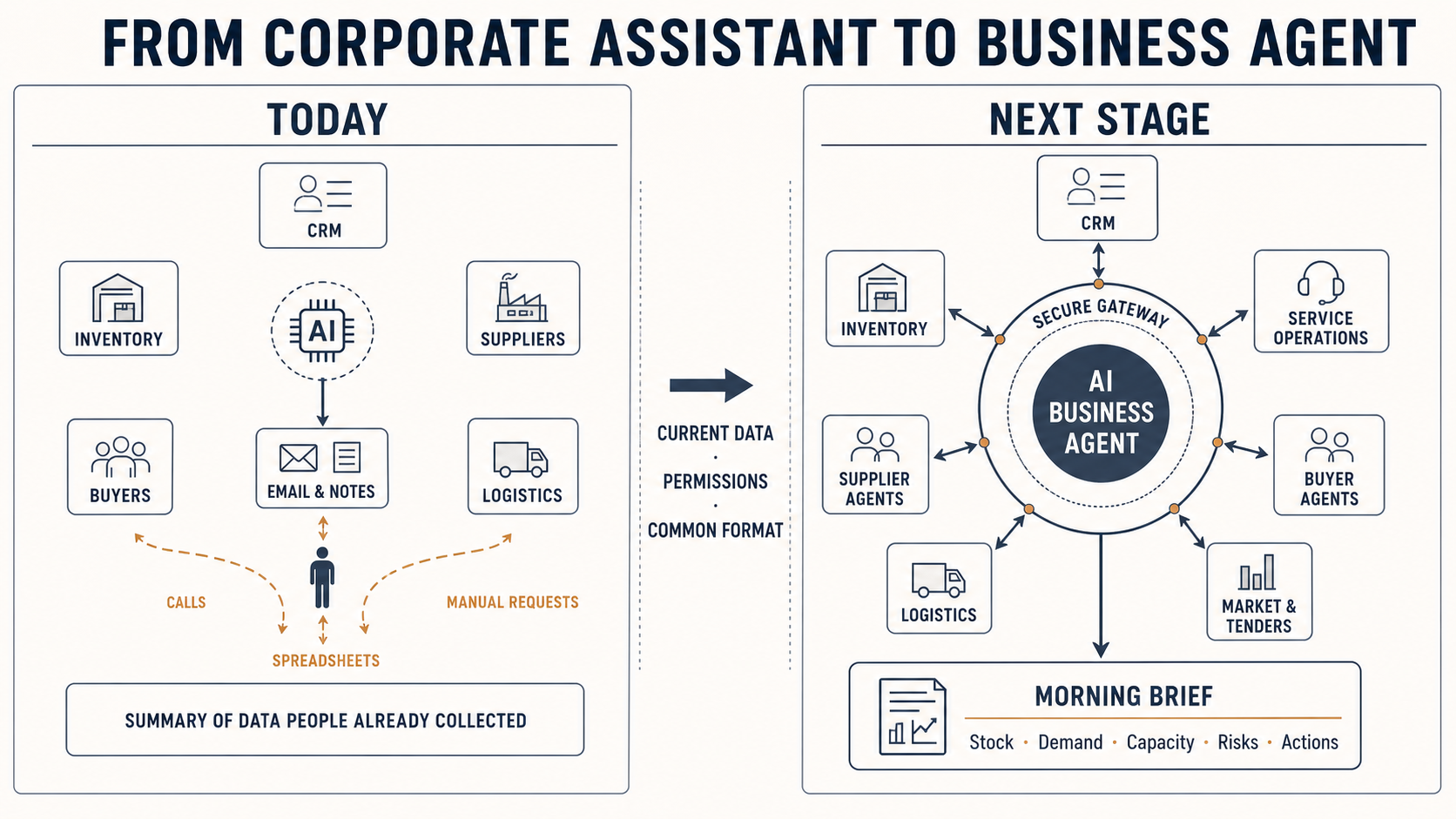
Inside a company, the current generation of corporate assistants can already review email, notes, CRM records, warehouse data, shipments, reports and documents. At NF ELIT, I see the practical value of this every day. A well-prepared internal knowledge layer saves real working time.
The problem starts at the boundary.
The moment I need a supplier's current inventory, a buyer's demand, a competitor's price or a carrier's free capacity, the old human process returns. A manager sends a request. Somebody on the other side checks another system. The answer comes later, often in a different format, sometimes without a timestamp or the fields needed to make a decision.
AI can organize the information that reaches it. It cannot make yesterday's supplier file current. It cannot infer whether a truck is still free. It cannot know that a price excludes delivery if nobody recorded the term.
A smaller inexpensive model working with clean, current and structured information can be more useful than a powerful model staring at stale noise. As model costs fall, the quality of the information layer matters more, not less.
Current data has its own clock
Companies often put documents and live operational data into one large category called "knowledge." They behave differently.
A product specification may remain valid for a year. A supplier inventory file may be useful until noon. Truck capacity can change in an hour. A container schedule can change while the cargo is already moving. A tender or new construction project may become commercially important on the day it appears.
So "current" needs a definition for every kind of data:
- Supplier inventory needs an update time, warehouse location, product identifier, available quantity and allocation status.
- A competitor price needs a currency, region, quantity, delivery terms, source and observation time.
- Truck capacity needs the lane, equipment type, available date, location and confirmation status.
- A container route needs the service, ports, cutoffs, planned milestones and live exceptions.
- A market signal needs a source, date, organization, project stage and a reason it matters to our segment.
A number without this context is not reliable business information. It is a clue.
This is why the external data problem is harder than adding another search box. Valuable sources are often expensive, fragmented or licensed for narrow use. Free sources are frequently inconsistent, incomplete and slow to update. Many industry portals offer only a visual interface. A person can open the page and click through it. An agent has no stable API, no freshness guarantee and no common format.
The morning brief I actually want
Imagine opening one report at the start of the day.
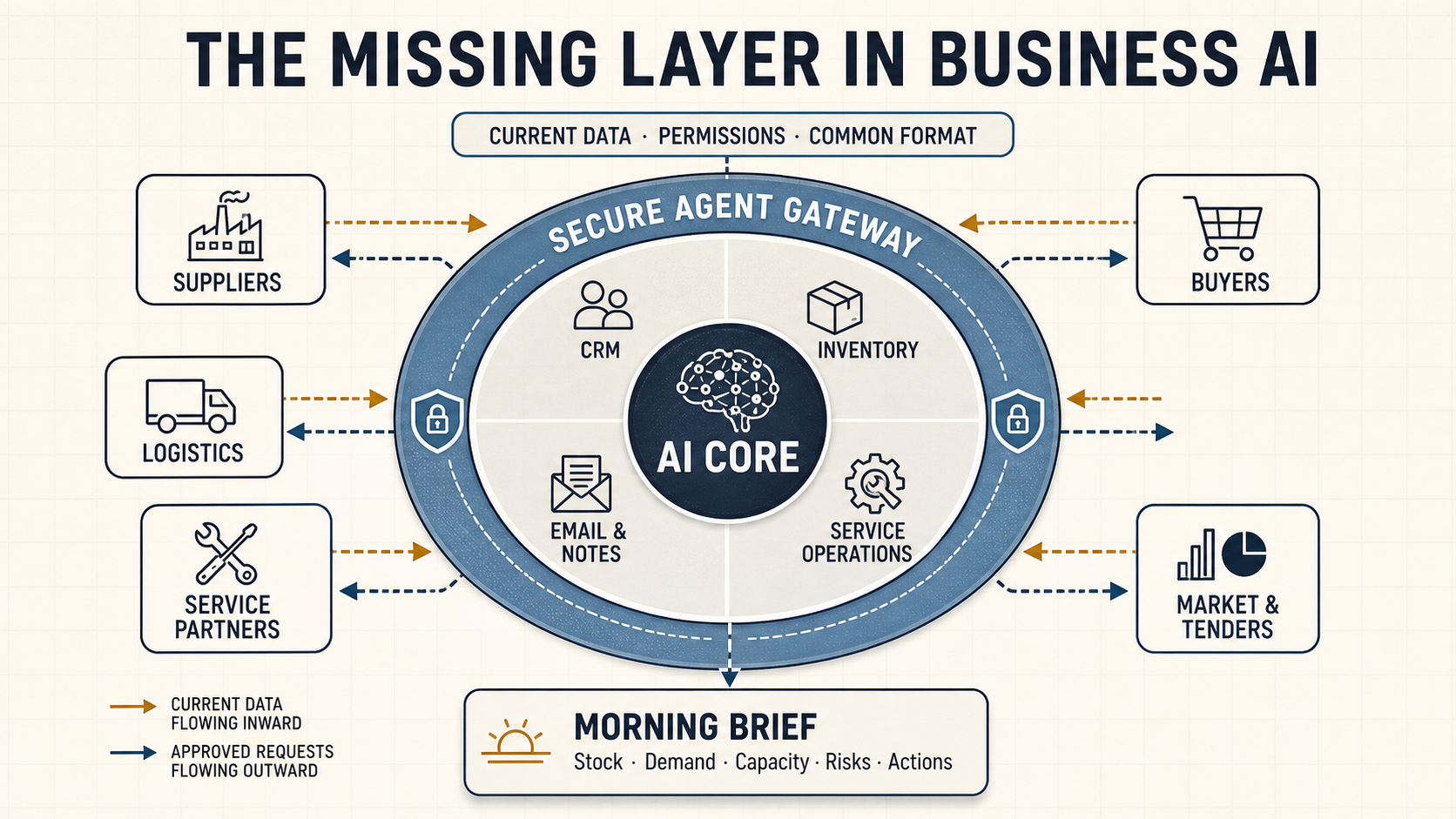
The agent has already checked internal stock, incoming shipments, open orders, recent email and manager notes. Then, within approved limits, it has asked supplier systems about current inventory, logistics systems about capacity and schedules, and public or industry sources about projects, tenders and relevant market changes.
The report does not give me another pile of information. It answers operational questions:
- What can we sell and deliver today?
- Where has new demand appeared?
- Which supplier has the right product now?
- Which prices, quantities or delivery terms changed?
- Where can a transport problem affect a promise to a client?
- Who should receive an offer today, and why?
Every answer carries its source and last update time. When the source is weak or old, the agent says so.
That would change AI from a corporate reader into an operating participant.
When one company agent can ask another
The next step is not a shared database where everybody sees everything. Corporate data must remain protected.
I imagine a controlled exchange of approved answers.
My company's agent asks a supplier agent whether 60 cubic meters of a particular LVL specification are available this week. The supplier agent checks its inventory system, applies its disclosure rules and returns an answer with warehouse, quantity, validity period and commercial contact. A logistics agent checks whether equipment is available for the lane. A buyer agent can publish an approved demand signal without exposing the buyer's internal planning.
The agents do not exchange entire CRMs. They exchange facts permitted for a defined purpose.
That requires identity, access rules, product dictionaries, request limits, timestamps, expiration, source records and an audit trail. It would feel less like a public marketplace and more like a protected business internet where data can move without making the companies transparent.
Parts of this infrastructure already exist
We are not starting from zero.
The Model Context Protocol gives models a standard way to connect with tools and data sources. The Agent2Agent Protocol addresses communication between independent agents.
Business networks already use narrower standards. X12 transaction set 846 carries inventory inquiry and advice. GS1 EPCIS records supply-chain events. The Digital Container Shipping Association publishes standards for commercial schedules and track and trace. Freight platforms such as DAT and Truckstop expose integration interfaces for parts of the road freight market. Catena-X is building a governed data ecosystem for the automotive industry.
These are examples of components, not one finished answer. They show that the technical pieces are possible. What is still missing for many small and midsize companies is an affordable, practical connection layer across industries, systems and business relationships.
The missing product may be a set of resource layers
The valuable niche may belong to the people who build and maintain those connections.
An industry resource layer would do more than collect links. It would include:
- connectors to CRM, inventory, transport and service systems;
- product and company identifiers that different businesses can match;
- rules for freshness, validation and source quality;
- filters controlling what an agent may request and disclose;
- a common response format, even when the source still has a primitive visual interface;
- sector packages for building materials, road freight, container shipping, construction projects, tenders and other operational markets.
The point is not to buy a subscription to every source. The infrastructure gap itself is the issue. Today each company repeats the same work: finding a source, extracting data, translating fields, checking dates, deciding whether it can be trusted and building a private connector.
If a resource is current, maintained and ready for an agent to use under clear rules, it has direct operational value. I would use it in my own work.
Fine-tuning and prompting sit on top of the information layer
This also changes how a company should think about model training.
Fine-tuning is useful for stable behavior: company terminology, product classification, document patterns, accepted response formats and examples of good decisions. Prompting defines the task, boundaries, tool choice, escalation rules and the shape of the answer.
Current inventory, a live price or today's truck capacity should not be trained into model weights. Those facts belong in retrieval systems, APIs and authorized agent requests. They need timestamps and source links.
The stack becomes fairly clear:
- Stable company rules and examples shape model behavior.
- Structured internal knowledge supplies corporate context.
- Live systems report the state now.
- External resource layers bring approved market and partner data.
- The agent combines the pieces into an answer and an action.
The model is the kernel. The information architecture determines whether the kernel can work.
The company itself has to change
There is another part that receives less attention.
Corporate communication was designed around a familiar chain: boss, manager, department, employee. Information moves through people. A request becomes a message, then a reminder, then a spreadsheet, then a report for the boss.
An agent environment changes that flow. Agents can collect routine facts, compare systems, request approved data from partners and escalate exceptions. This works only when the company decides what an agent may ask, what it may disclose, which systems are authoritative, who approves an action and who owns a mistake.
Employees also have to make their work legible to the system. Product codes, dates, commitments, owners and status fields cannot remain hidden inside casual messages. Management has to move part of its attention from carrying information to designing rules and resolving exceptions.
This may be harder than connecting an API. We are not only adding AI to an old company. We are redesigning parts of corporate communication so that people and agents can work in the same operating system.
The questions are still open
Will companies allow their agents to exchange verified operational facts?
Who will build the identity layer, filters, permissions, dictionaries and connectors between them?
Can small businesses enter this network without funding a custom integration for every partner?
Will managers be ready to replace part of the old information chain with rules, machine-readable processes and exception handling?
And will AI move to the next level of corporate integration, or remain a very capable summary tool for information that people still collect by hand?