A smart model cannot help if it has no one to call
One morning I open my email and realize three of my containers are going the wrong way.
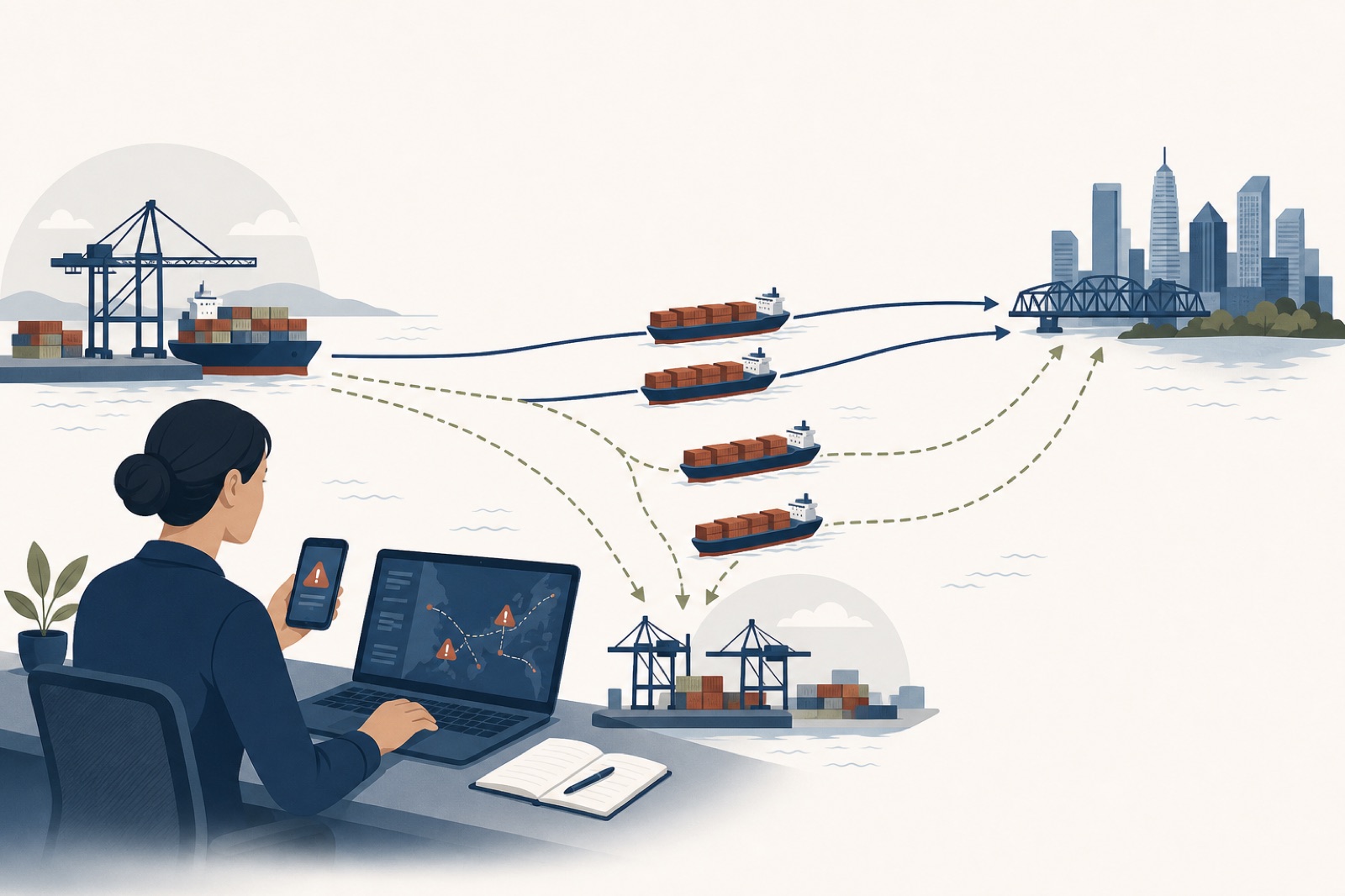
The plan was normal. Five containers leave Istanbul, transship in Rotterdam, then continue on one vessel to Baltimore. One vessel. The client has already reserved warehouse space, booked trucks and assigned the cargo to his own projects. In Baltimore we are supposed to clear customs, inspect the shipment and move it directly onto the client's trucks without bringing it through our warehouse.
Two containers leave Rotterdam on the correct vessel. Three go to Houston first. They will still reach Baltimore, but five or six days late.
On paper, a small routing change. In operations, everything is already burning.
On one side you have the carrier and several agents. One does not answer the phone, another asks for an email, the main operator communicates only in writing, and the local port agent starts working once the cargo has arrived. On the other side you have the client. He has trucks, people, warehouse slots, deadlines, promises made to his own customers. He does not care which link made the mistake. His logistics chain was built on mine.
I cannot just call and say, "We have a delay." First I need to know what happened, whether the cargo can be redirected, how long the delay will actually be and what I am proposing to do. I need that answer within an hour. Two at most.
That is the moment when you see where a smart model ends and the real job begins.
For now, the human is still the API
During route planning, a model is useful. You give it the origin, destination, dates, constraints and cargo details. It asks for missing information, compares options, builds a plan. If it has access to corporate email, calendars and alerts, it can monitor the shipment, flag important changes and prepare replies.
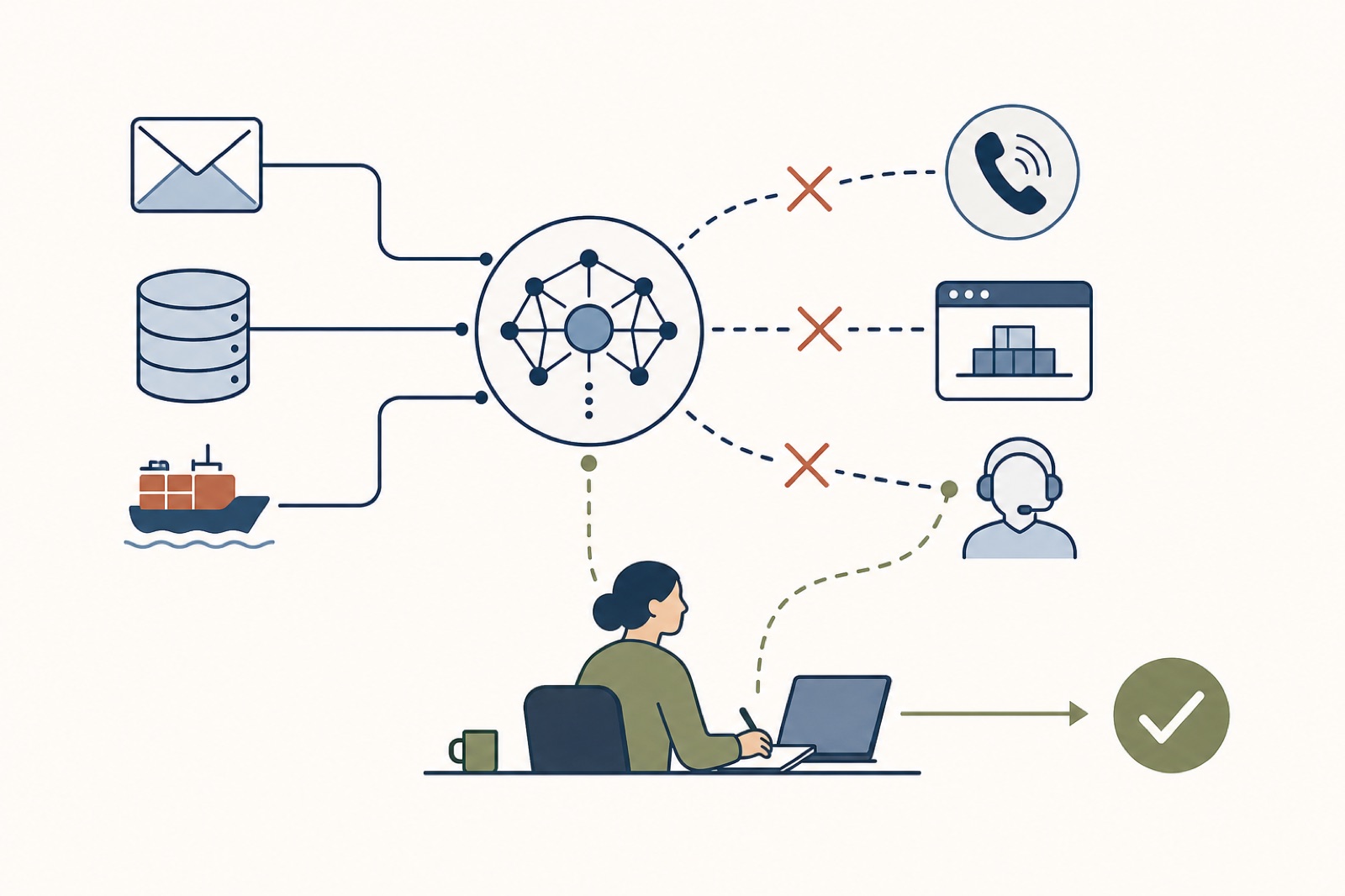
But part of the data sits behind paid databases, private carrier portals and internal systems. Some of them have no API. Sometimes you have to call a person and hear whether he has a solution or is simply passing the responsibility to somebody else.
In a critical moment the model is not connected to the whole network. So I become its input device. I call, talk, email support, collect fragments, feed them back to the model and ask again. It can help me assemble the picture. I still have to execute the decision.
I'll tell you straight: this is where the story about a super-agent with an unlimited budget gets thin. If it cannot reach the people, systems and live state of the cargo, more tokens will not save it.
Technically, a modern AI system is no longer one model. Around it sit tools, retrieval, external memory, permissions, code execution, monitors, sometimes several agents running in parallel. The model is the engine. Without the road, brakes and connection to the outside world, the engine is just making noise in a garage.
The model race is useful, but architecture is dividing the work
Competition is good in any industry. In computing and AI, even more so. Labs push each other on quality, price, speed, context size and tool use. The user wins.
At the same time, the base capability of strong models is getting closer in my daily work. ChatGPT, Claude, DeepSeek and other systems are not night and day. One writes a better email. Another searches more comfortably. One is concise. Another writes a wall of text nobody asked for.
Under the hood, the differences are serious. The dense Transformer is still the mature general-purpose base. Mixture of Experts, or MoE, increases total capacity without activating every parameter for every token. DeepSeek-V3 and the larger Qwen3 models use this design. Qwen3 also released dense models at the same time. Nobody has replaced everybody else.
Hybrid systems divide the work again, combining full attention with cheaper sequence mechanisms. Those mechanisms help with long input, while full attention still matters when the model needs precise content-based retrieval.
For the user, the architecture name matters less than the result of the whole system: quality, latency, cost, memory, retries, failure rate. A beautiful kernel benchmark has never completed a customer job.
The real competition is moving there. Which system handles uncertainty, notices missing data, chooses the right tool, checks its own result and keeps the goal after fifteen steps?
One good answer and a reliable process are different things
Take a process with twenty steps. Each step is correct 95 percent of the time. That sounds decent. If the steps are independent, the chance that all twenty are correct is roughly 36 percent. Raise each step to 99 percent and the full process still lands around 82 percent.
Real work is more complicated than this calculation. Some steps can be checked, repeated or rolled back. Errors can depend on each other. The principle still holds.
One good model answer is getting cheap. A reliable chain of decisions is still expensive.
DeepSeek-R1 is a useful example. Its researchers showed that reinforcement learning can improve reasoning when the result can be checked strictly. Mathematics, code, structured STEM tasks. The model tries, a verifier checks the answer, a correct attempt gets the reward. It works.
The same paper also describes the limits. R1-Zero had readability problems, mixed languages and remained narrow outside verifiable reasoning tasks. The final R1 required a multistage process combining RL, supervised fine-tuning and additional data. DeepSeek-R1 in Nature
There is no single verification button in my shipping problem. A client may accept one recovery option and reject another. An agent may say a reroute is possible, then an hour later you learn the vessel has sailed. The carrier can satisfy the contract on paper and still break the client's chain.
This is why verifiers matter so much for agentic systems. The better a model gets at optimizing a metric, the more dangerous a bad metric becomes.
METR measures capability through task-completion time horizons. The number represents the human duration of tasks at a difficulty where an agent has a given probability of success. It is not the time the model literally works, and it is not a percentage of jobs automated. METR also warns that estimates above 16 hours are unreliable on the current task set. METR Time Horizons
A 50 percent horizon is interesting for capability. If the system moves money, changes access or writes to a client, I want 80 percent, 95 percent, an action log and a rollback path.
Pilots still read the checklist after twenty years on the same aircraft. Every time. That every time is the point.
One million tokens can still miss three containers
Long context is another place where the label gets ahead of the work. Some models accept one million tokens or more. The input window tells you how much can fit. It does not tell you how well the model compares distant evidence, ignores noise, preserves order and builds a conclusion across the whole set.
RULER and NoLiMa separate advertised context from effective context. A model can find a literal needle and struggle when the match is semantic, evidence is scattered and the surrounding text is full of distractions.
In my case I could load the entire correspondence for five containers, hundreds of emails, alerts, contract terms and vessel schedules. But if the system does not understand that two container numbers belong to the direct vessel, three are routed through Houston, and the client's deadline depends on the full shipment arriving, a large context window becomes a large warehouse. Plenty of space. No order.
My process is simpler. I give the model a knowledge base or a set of source documents, define the working area, the task and the required output. I want a concise structured result: the core decision, weak points, risks, what would strengthen it. Then I run several iterations.
For an important decision I start a new chat, provide the same source material and ask for the analysis again. I make the model check itself without carrying the weight of the first conversation.
A giant context window does not replace this. I prefer a loop: request, answer, update the short state, remove what no longer matters, send the next request. No need to pull the whole train just because it fits.
Memory is not the same as learning either. Files, summaries, vector databases and RAG are external memory. Useful, yes. They do not update the base model's weights. Save one wrong summary and retrieve it ten times, now the system confidently remembers its own mistake. General continual learning without forgetting is still a research problem.
Token price is no longer the main number
When ChatGPT first appeared, it felt like a small miracle. I enjoyed simply talking to it, asking about whatever caught my attention, using it as a different kind of search engine. I had not started studying computer science yet and did not understand the mathematical product behind the chat. Maybe they had actually invented artificial intelligence.
Then people got used to it. Played with it long enough, if I say it plainly.
Now efficiency comes first. How briefly can I explain the task? Will the model understand the intent without ten pages of prompting? Will it give a short answer when a short answer is enough? What does the completed job cost?
This is why some of the most mature progress is happening below the model. PagedAttention manages KV cache more efficiently and raises serving throughput. DistServe separates compute-heavy prefill from memory-heavy decoding. Prefix caching avoids repeating the same prompt work. Speculative decoding lets a cheaper path propose tokens and the main model verify them.
Papers report gains of several times under specific test conditions. You cannot multiply them together. Two optimizations may attack the same bottleneck. A gain on a short prompt can disappear on a long one, and a system tuned for throughput can miss its latency target.
The honest metric is the cost of one successfully completed task at a fixed quality level. Retries, human review, cleanup, all of it belongs in the number. Not just tokens.
The less you know, the more expensive delegation becomes
I did not use language models in cleaning. I left that field before they arrived. But the principle is the same in cleaning, warehouse work, production lines, team management and logistics: operational work values accuracy and control. Beautiful prose does not help if the number is wrong.
If I know the field, I can check the model's answer and get real value. If I enter a profession or business I know nothing about and accept its answer on faith, sooner or later there will be a problem. The model says correct and incorrect things in exactly the same confident voice.
People will delegate more anyway. That growth will run into compute, energy, HBM, networks, cooling and heat removal. The International Energy Agency estimated that all data centers used about 415 TWh of electricity in 2024 and projects around 945 TWh in its base case for 2030. That includes all data centers, not AI alone, but the scale is clear. IEA Energy and AI
Slides can promise anything. The electrical grid is less cooperative.
In five years AI will be everywhere, and more specialized
I expect AI in almost every device, including home systems. Alongside large general models, we will see more systems trained or assembled for one field from the start.
A logistics model will know vessels, ports, documents, constraints and common failures, and know nothing about filmmaking. A cleaning model will understand materials, contamination, staffing and the cost of a site, and know nothing about space. A narrow system can be more useful than a universal conversational model if it is integrated deeper into the real process and has access to the right data.
I do not think AI will simply take everybody's job. I expect the internet, social platforms, books, articles and images to fill with cheap low-quality material. Then work made by human hands will become valuable again. We may even get a new kind of verification: this text, book, image or product was made without AI.
Funny result. First we proved that a machine made something. Then we will prove that a human did.
The line appears when somebody has to answer for the decision
AI can already plan, search, compare, write, calculate, read email and call tools. It will do more of this, faster and cheaper.
But when two containers are heading to Baltimore, three suddenly go through Houston, the agent does not answer, the carrier accepts only email and the client is already calculating penalties, you do not need another beautiful answer.
You need to get somebody on the phone. Collect the facts. Make the decision. Answer for it.
For now, that is the line.